
Flat Roof Repair in Pembroke Pines — Low-Slope Membrane & Coating Restoration
Flat and low-slope roofing systems handle water differently than sloped roofs — and they fail differently too. We repair membrane punctures, open seams, ponding issues, and coating failures across TPO, modified bitumen, EPDM, and built-up roofing systems throughout Pembroke Pines.
Signs Your Flat Roof May Be Compromised
Flat roofs don't shed water the way sloped roofs do — which means small failures can lead to significant water intrusion more quickly. These conditions suggest your flat roof needs professional attention.
Water pooling that remains hours after rain stops
Persistent ponding indicates drainage problems — whether from membrane settlement, clogged drains, or inadequate slope. Standing water accelerates membrane deterioration and increases the likelihood of leaks at seams and terminations.
Blistering, bubbling, or wrinkled membrane surface
Blisters and bubbles in the membrane indicate trapped moisture or gas between layers. These areas are structurally weaker and can rupture from foot traffic, thermal stress, or debris impact — creating direct leak paths.
Visible separation at membrane seams
Seams are the most common failure point on any flat roof membrane. When adhesive fails, welds separate, or the membrane contracts, seam openings allow water beneath the membrane where it can spread undetected across the roof deck.
Surface cracking or alligatoring on the coating
On coated or built-up flat roofs, a pattern of surface cracking — sometimes called alligatoring — indicates the coating has lost its elasticity and is no longer protecting the membrane layers beneath from UV and water.
Safe Observations for Flat Roof Owners
Observe the roof surface from an upper window if available
Check for visible ponding water, debris accumulation, or obvious membrane damage that can be seen from above.
Check interior ceilings directly beneath the flat section
Flat roof leaks often appear as ceiling stains in the room directly below. Check for moisture, discoloration, or soft spots.
Monitor drain performance during rainfall
If you can safely see the roof drains, watch whether water flows toward them properly or appears to pool in areas away from the drains.
How Flat Roofs Fail in South Florida
Membrane Seam Separation
The most common flat roof failure. Adhesive bonds and heat welds degrade over time, allowing seam edges to open and let water beneath the membrane where it spreads across the insulation and deck.
Ponding and Drainage Failure
Insufficient slope, clogged internal drains, or deflected structural members cause water to pool rather than drain. Persistent ponding adds weight, accelerates membrane breakdown, and eventually finds or creates entry points.
Punctures and Mechanical Damage
Foot traffic, dropped equipment, and debris impact can puncture or tear flat roof membranes. Even small punctures allow water to bypass the membrane entirely, reaching the insulation and deck below.
Why Flat Roofs Need Membrane-Specific Repair Methods
Flat roof repair isn't a generic process. Each membrane type — TPO, EPDM, modified bitumen, PVC, built-up — has its own properties, bonding methods, and compatible repair materials. Using the wrong patching material, adhesive, or seaming technique on a specific membrane type can actually make the problem worse.
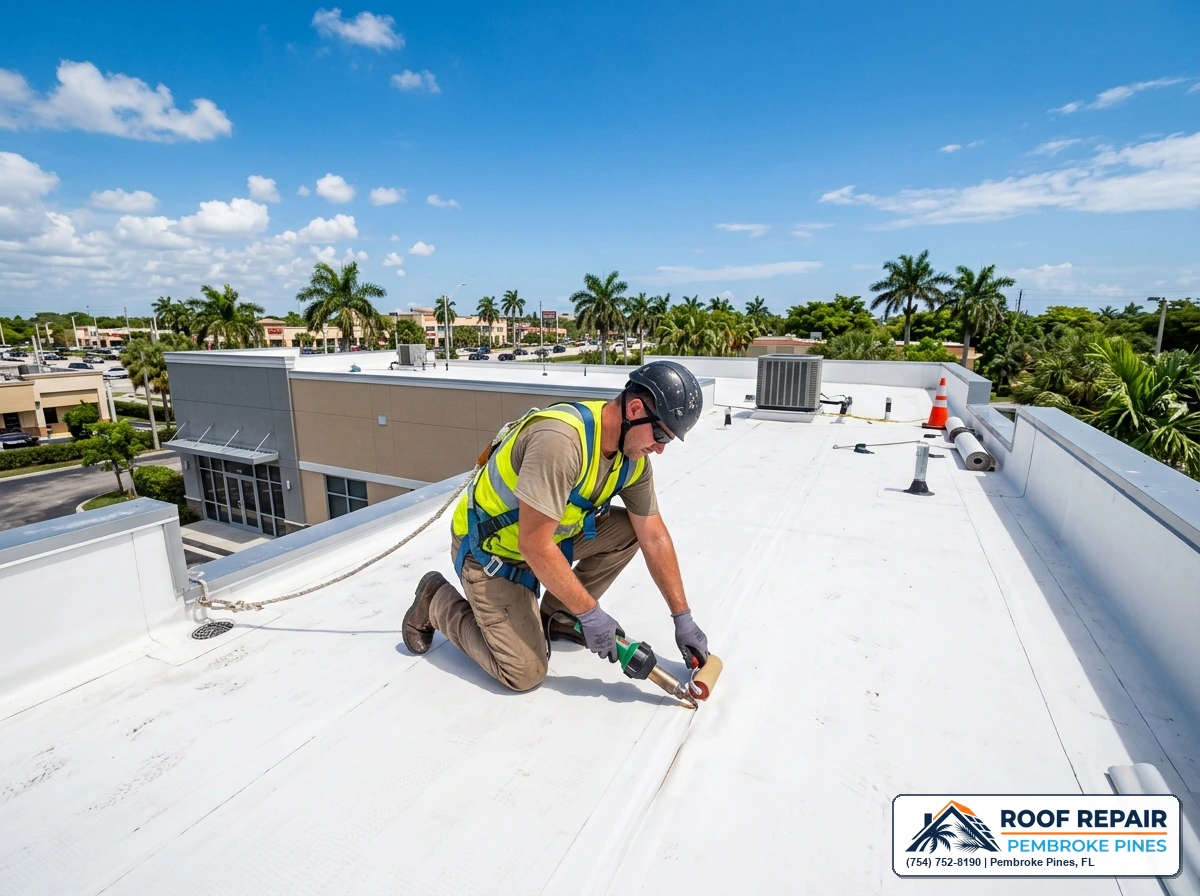
For example, EPDM requires compatible adhesives and uncured rubber patches. TPO requires heat welding with specific temperature settings. Modified bitumen repairs typically involve torch-applied or self-adhered cap sheet patches. A repair that works perfectly on one membrane type may fail entirely on another.
Homeowners and property managers seeking professional flat roof repair in Pembroke Pines should ensure their contractor identifies the existing membrane type before beginning any repair work.
How Flat Roof Repairs Are Approached
Identify the Membrane Type and Condition
We identify the existing membrane system — TPO, EPDM, modified bitumen, BUR, or PVC — and assess its overall condition including seam integrity, surface wear, edge terminations, and areas of ponding or debris accumulation.
Locate Active and Potential Failure Points
We inspect the membrane surface for open seams, blisters, punctures, and deteriorated flashings. On flat roofs, water can travel significant distances beneath the membrane before appearing as an interior leak, so we evaluate the entire drainage path.
Apply Membrane-Compatible Repairs
Using materials and methods specific to the identified membrane type, we repair seams, patch punctures, reseal terminations, and address any drainage issues. Each repair is completed using manufacturer-compatible products for that specific membrane system.
Evaluate Drainage and Test the Repair
After the repair, we verify that the repaired area is properly sealed and that surrounding drainage is functioning. If ponding was part of the original problem, we identify whether drainage improvements are needed to protect the repaired area long-term.
Flat Roof Repair FAQ
Ponding usually results from inadequate slope, sagging structural members, clogged or poorly positioned drains, or areas where the membrane has settled over time. Standing water accelerates membrane deterioration and increases the risk of leaks.
Modified bitumen and TPO are the most common. Built-up roofing (BUR) is found on older properties, while EPDM and PVC are also present. Each has its own repair methods and material compatibility requirements.
In some cases, yes — if the existing membrane is structurally sound. Elastomeric coatings can extend the life of certain membrane types. However, coatings cannot fix open seams, significant membrane damage, or active leak paths.
Without a professional inspection, it's difficult to determine. Both are common failure points. Seam failures often produce wider leaks, while penetration failures tend to concentrate around specific points — but water travel across a flat deck can make either appear elsewhere.
Related Flat Roofing Services in Pembroke Pines
Concerned About a Flat Roof Leak? Have the Problem Area Inspected
If you've noticed ponding water, blistering, separated seams, or ceiling stains beneath your flat roof — contact us for a professional evaluation. We'll identify the membrane type, locate the failure, and provide a membrane-compatible repair plan.